



Business owners and HR managers are always looking for ways to boost efficiency while ensuring their staff are treated fairly.
On paper, the Bradford Factor appears to do just that, allowing managers to calculate a score for each of their staff and determine how their use of sick days might be impacting the company.
So, how exactly is a Bradford Factor score calculated? And is it actually legal to use a formula as a basis for evaluating, or even dismissing, staff? We cover it all below.
But first things first...
What is the Bradford Factor?
The Bradford Factor is an absence management method to determine the impact of staff absenteeism. It's based on the theory that frequent short, unplanned absences impact businesses more than long-term absences.
Despite MetLife UK's 2025 report revealing long-term staff absences cost UK businesses more than short-term (£20,735 per employee a year vs. £13,800 per employee a year), the theory behind the Bradford Factor suggests short-term absences hold more hidden costs from their impact and loss in productivity caused.
While short-term absences may not seem disruptive, an employee's Bradford Factor sickness score will be higher the more instances of short-term sicknesses they have.
How to calculate Bradford Factor
Rather than just tallying up the number of days an employee has called in sick, the Bradford Factor formula multiplies the number of instances, or “spells”, of unplanned absence by the total number of days the absence was for.
The Bradford Factor formula is: S² x D = B.
- S = The number (or spells) of absences
- D = The total number of absent days during 52 weeks
- B = The Bradford Factor score
The higher the score, the more frequent the periods of absence have been.
Example Bradford Factor scores:
- 1 absence of 10 days = score of 10
- 2 absences totalling 10 days = score of 40
- 5 absences totalling 10 days = score of 250
- 10 absences totalling 10 days = score of 1,000
You can use the Bradford Factor formula to calculate employees' Bradford Factor scores yourself.
(Or perhaps a Bradford score calculator would help.)
Try our Bradford Factor score calculator:
...Or track Bradford Factor automatically
Instead of calculating sickness scores manually, RotaCloud automatically tracks employee absences, creates and keeps absence records, and gives you complete visibility of overall attendance and patterns.
Book a free demo to see it in action OR–
Start your 30-day free trial with RotaCloud to have a play yourself.
What's next?
You've calculated your Bradford Factor score... But what does it mean?
What is a good Bradford Factor score?
Managing employee absence fairly
Altnernatives to Bradford Factor
More FAQs
What is a good Bradford Factor score?
Bradford scoring and its Factor trigger points are completely flexible and vary from company to company, so it’s hard to identify a “good” or “bad” score.
However, the idea is: the lower the points, the better the Bradford score; the higher the points, the worse the Bradford score.
Possible Bradford Factor trigger points (or thresholds)
- 0–50 points: No action is taken
- 51–124 points: An informal absence review
- 125–399 points: A formal absence review
- 400+ points: A potential disciplinary investigation
An example:
When considering the Bradford Factor formula (B = S² x D)...
If Jeff calls in sick six times (S = 6), taking two days off on one occasion and one day on each of the other five (therefore D = 7), then his Bradford Factor score would be 252 (because 6 x 6 x 7 = 252).
If Amelia has only two spells of absence in the same year but takes more days off (three days on one occasion and six days on the second), then her Bradford Factor score would be 36 (2 x 2 x 9 = 36).
According to the Bradford Factor theory, even though Amy took two more days off than Jeff, her Bradford score is significantly lower than Jeff's (36 versus 252) because her absences were less frequent.
Managing employee absence fairly

Is it legal to use the Bradford Factor as a basis for dismissal?
Providing that a company sets realistic trigger points, it’s entirely legal for managers to use Bradford Factor scores as a basis for taking action against employees who are frequently absent.
A word of warning, however: some disabilities and illnesses may prevent a person from coming to work on occasion, thus negatively skewing their Bradford Factor score. To dismiss such an employee would be hugely unfair, not to mention in violation of the Equality Act 2010.
Why is the Bradford Factor controversial?
The Bradford Factor is sometimes considered controversial because it's often used as an inflexible disciplinary tool without taking into account an employee’s unique circumstances, such as chronic illnesses or disabilities, as mentioned above.
As well as not taking into account individual circumstances, another criticism of the Bradford Factor is that it doesn’t take into account the circumstances of the business or team. For example, in some sectors, frequent short absences may be far less disruptive than less frequent longer absences — the Bradford score’s ‘one-size-fits-all’ approach is a benefit, but also a problem.
The formula also raises the wider problem of discouraging staff from taking sick leave so that they avoid disciplinary action. Employees with contagious illnesses will pass on their ailment to other staff, further increasing disruption — but if a poorly employee knows that taking another sick day will lead to a formal warning, they’ll probably come to work to avoid that. The ongoing pandemic only makes this problem more pressing.
Bradford Factor pros and cons
Before deciding whether or not to make the Bradford Factor a part of your absence management strategy, it’s important to be aware of its pros and cons.
Pros:
- Having a clear scale on which all staff are measured is fairer than leaving decisions about how to respond to absenteeism to the discretion of one person.
- Gives both managers and employees something concrete to refer to when discussing attendance.
- Bradford Factor trigger points can be tweaked to fit management styles, with less autocratic managers allowing for a higher number of sick days to be taken before issuing warnings.
Cons:
- Flexible trigger points run the risk of becoming entirely arbitrary if not properly thought out, leading to staff being judged unfairly.
- Those who have disabilities or conditions like asthma or epilepsy may feel discriminated against as their conditions can result in occasional bouts of short (but much-needed!) periods of absence.
- Discouraging shorter spells of absence could potentially lead to staff deciding to come in while still ill (presenteeism), bringing things like colds and flu into work and passing them on to the entire team.
Tips for using the Bradford Factor effectively
The Bradford Factor can be hugely helpful for human resource managers, offering them a yardstick by which to compare their entire team and identify staff who could be costing the company hundreds, if not thousands, of pounds a year.
By introducing them to the metric, staff usually respond positively, too, seeking to avoid taking too many “sickies” each year and having them affect their score.
But managers should also be wary of letting a one-size-fits-all formula shape their decisions too much.
Rather than firing off a written warning the moment a member of staff’s Bradford Index creeps into the next category, prudent HR managers should see this as an opportunity to meet with their staff to discuss the causes of their repeated absences.
It’s easy to write off occasional days off as staff pulling a fast one — especially if their sick days happen to fall either side of a weekend.
But frequent absence can be a sign that something isn't quite right. There are plenty of legitimate, serious reasons why a member of your team might be calling in sick so often, such as:
- Stress and anxiety
- Depression
- Illness in the family
- Bullying in the workplace
- Acute physical illnesses that flare up only occasionally
- Lack of engagement with their work
Although they're sometimes reserved for longer periods of absence, it’s a good idea to have a back-to-work scheme in place and to follow it even when a member of staff takes just a day or two off.
The Bradford Factor might be great for businesses that value efficiency before all else, but numbers alone won’t tell you whether someone is having trouble at home, or indeed if they are unhappy in their job and need your help.
You could simply dismiss staff who have high Bradford Factor scores, ensuring that only those who score well remain in the company. But even the most results-focused, data-driven business moguls will agree that replacing a member of staff will usually end up costing the company far more than ensuring that those in your existing team are motivated and happy at work.
Metrics like the Bradford Factor can be useful for managers, but it's best to use them to help you spot issues that need your attention rather than letting them make the decisions for you.
Alternatives to Bradford Factor
While it's possible to calculate employees' Bradford Factor scores manually, it's far easier for workforce management software to do it (and many other time-consuming tasks) for you.
By using absence mangement tools alone, managers can track attendance, access automatic records, and generate reports listing employees' worked hours and time off – as well as Bradford Factor scores – in a matter of seconds.
And that's on top of rota planning, holiday management, and payroll.
The Bradford Factor in RotaCloud
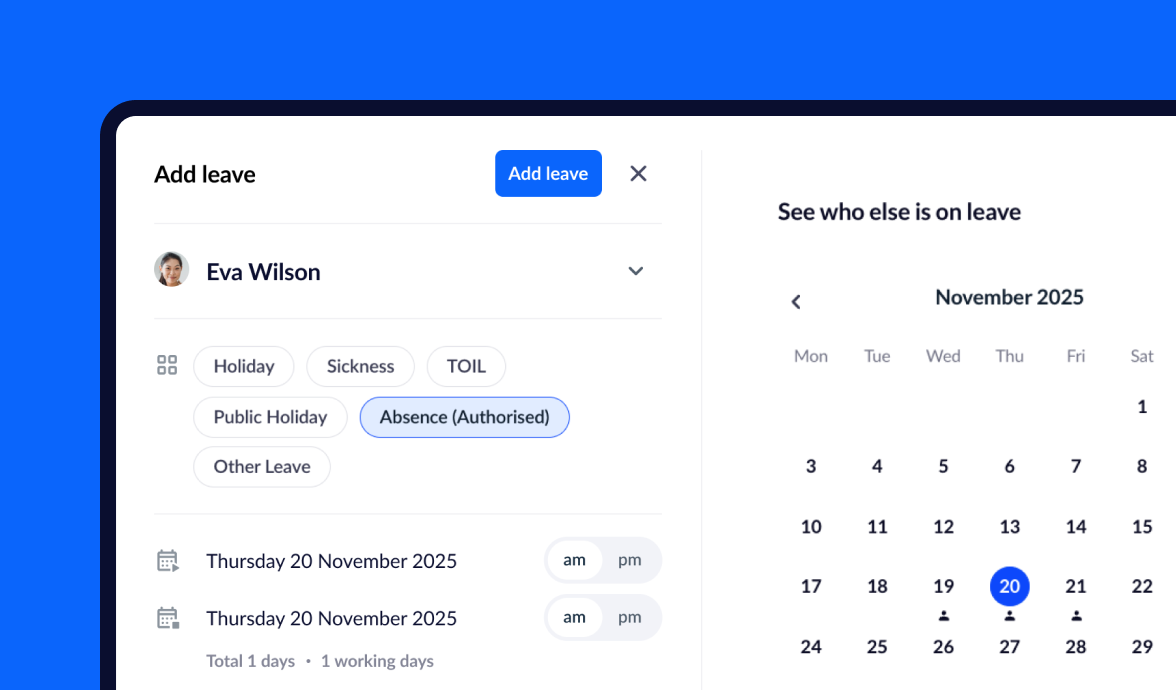
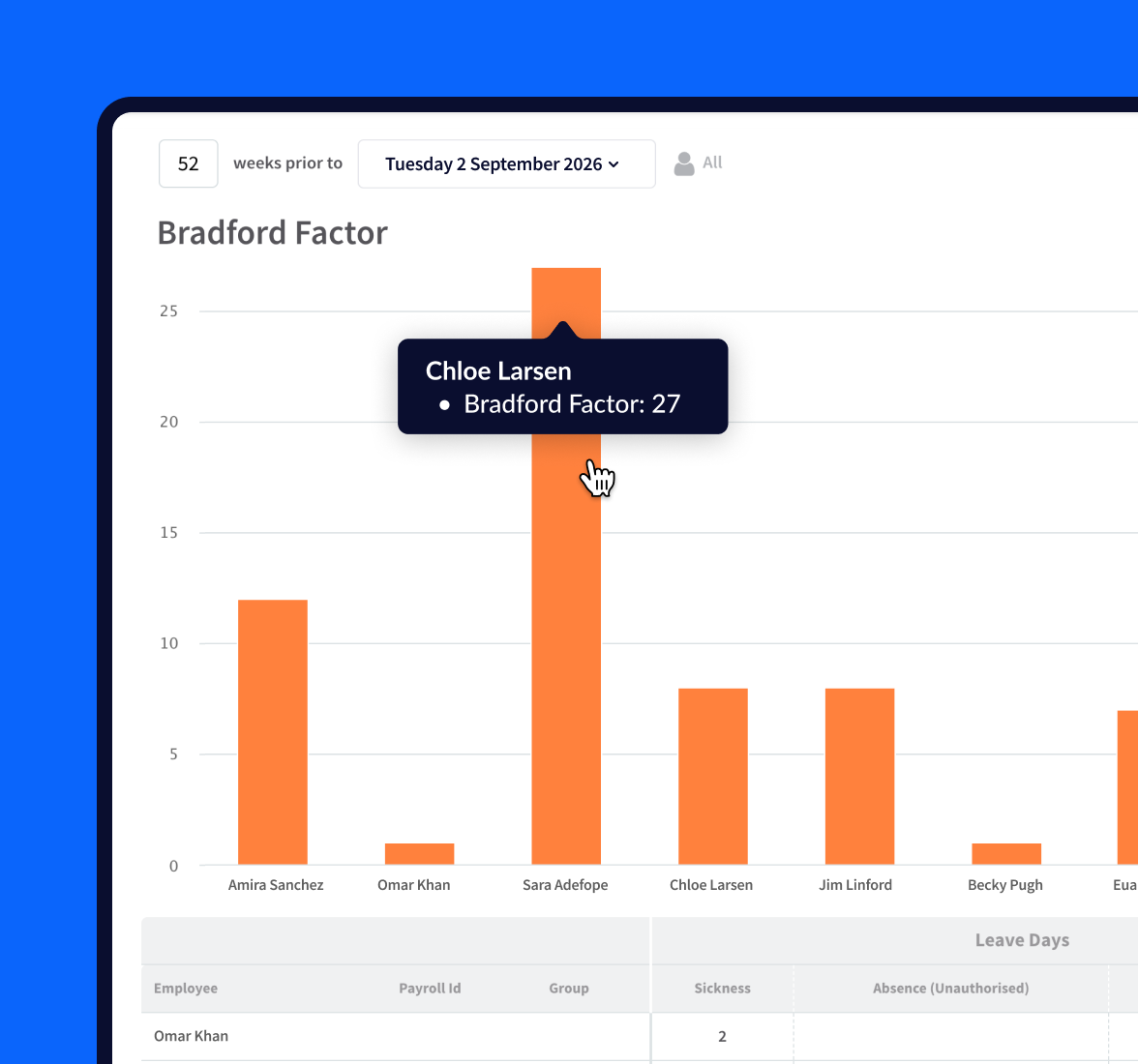
You can use your RotaCloud absence data to create Bradford Factor reports. Here’s how to do it:
- Add sickness and other absences via the Leave section, or employee timesheets where applicable.
- Under Financials → Reports, go to the Time Off & Cover section and select Bradford Factor.
- Choose a date range and the employees the report will cover. The report will update automatically when settings are changed.
- Review the graph and the full data table below it.
Online Time & Attendance software
Reclaim your workday with RotaCloud
Monitor clocking in and out, record employee working hours, manage payroll (and more) with RotaCloud.
- 30-day free trial
- No card required
More FAQs
Skip to:
Are frequent absences really more damaging than longer ones?
Why is it called the Bradford Factor?
How do you calculate a Bradford Factor score?
What is an acceptable Bradford score?
What are Bradford Factor trigger points?
When does a Bradford score reset?
Read next ➤

Absence management: a complete guide for SMEs
From types of absences to best practices, your absence management policies need to strike the right balance between deterring false sickness absences and making sure your staff take absences when they need them. How can you get that balance just right?
Are frequent absences really more damaging for a business than longer ones?
Whatever your opinion of the Bradford Factor itself, the thinking behind it (that frequent short absences are more detrimental to a business than fewer long absences) is fairly sound.
When a member of staff calls in sick, there’s little that a smaller business owner can do besides try to pick up and fill the gaps.
This could mean anything from calling your off-duty staff to ask if they can cover the shift at short notice, to taking on the work yourself and hoping that it doesn’t impact your other duties.
But if, for example, a member of kitchen staff suddenly comes down with gastric flu or breaks their arm, then their manager may be able to secure a replacement, knowing that their employee will be out for several days or more.
In truth, the basis on which the Bradford Factor's formula was originally formed is not entirely clear, with no single body laying claim to the theory.
But considering that sickness absence is estimated to cost UK businesses up to £20,735 per employee a year, according to MetLife UK's 2025 report, it’s not surprising that so many employers will consider using the Bradford Factor as a means of identifying the kind of absences that are the most financially draining.
Why is it called the Bradford Factor?
It’s thought that the Bradford formula is a result of research carried out by a team at Bradford University School of Management, but no professional body or person explicitly lays claim to the term.
The Bradford Factor is sometimes referred to as the Bradford score, Bradford scale, Bradford formula or Bradford Index.
How do you calculate a Bradford Factor score?
Employers use the Bradford Factor formula to measure the impact of frequent short-term absences in the form of a score.
B = S² x D
- S = The number (or spells) of absences
- D = The total number of absent days during 52 weeks
- B = The Bradford Factor score
The higher the score, the more frequent the periods of absence have been.
Manually calculating and monitoring Bradford Factor scores is difficult, especially as teams grow. But absence management software like RotaCloud helps managers track employee attendance, maintain records, and identify repeating absence patterns automatically.
What is a bad Bradford score?
Depending on the business and its Bradford Factor scale, a Bradford score over 100 could simply be a cause for concern. At the same time, other employers may begin to take action by monitoring or investigating.
Over 200 is considered, on average, a high enough Bradford Factor score for further investigation – and often warnings.
A Bradford score above 500 can often be grounds for dismissal, depending on the employee's or company's circumstances.
What is an acceptable Bradford score?
Anything below 50 is considered an acceptable Bradford Factor score and is typical for the average employee.
A Bradford sickness score between 50 and 100 can also be acceptable, but may be a cause for concern depending on the company and its Bradford Factor threshold.
Anything above a 125 Bradford Factor score can mean a formal absence review.
What are Bradford Factor trigger points?
Bradford Factor trigger points mark the thresholds that an employee's Bradford score can reach for certain actions to take place.
Trigger points vary and are flexible from business to business. But here's an example:
No action is taken if an employee's Bradford score is below 50 points, while points between 50 and 100 mark the trigger point for basic monitoring. Bradford points over 200, however, may trigger an investigation.
When does a Bradford score reset?
The Bradford Factor score often resets annually, most commonly at the start of the calendar or financial year, depending on the company.
Is the Bradford Factor still used?
Many UK employers still use Bradford Factor scores as part of their absence management process. However, some criticism of the Bradford Factor is that it's an unfair repusentation of someone's work.
This is why most organisations use Bradford scores alongside wider absence data, employee wellbeing information, and manager discretion rather than relying solely on an employee's Bradford Factor score.
Can Bradford Factor be used for disability-related absence?
Yes. Though employers shouldn't apply Bradford scores blindly.
Some disabilities and illnesses can cause a member of staff to be off work more often, which would negatively impact their Bradford Factor score. In this case, it's recommended to make reasonable adjustments to your business' Bradford Factor for disability-related absence.
As stated in the Equality Act 2010, a disability is a protected characteristic. To hold a disabled member of staff to the same Bradford Factor threshold as non-disabled staff would be unfair, and going as far as dismissing them would be in violation of the Act.
Editor's Note: This article was originally published in February 2017 and most recently updated in February 2025 and June 2026.